Indie Game Budget Example: How Many Copies Do You Need to Break Even?
A small team has six months of work left on a premium PC game. It can put $20,000 of its own money into finishing it. The remaining work costs $41,000. How much should the team ask a publisher for, and how many copies would it need to sell to earn its own money back?
In this example the funding gap is $21,000. With the deal below, the studio recovers its own cash at 8,625 purchases. Here is the budget and the arithmetic a publisher could use to check that figure. The numbers describe an illustrative project. They are not figures from an actual studio or typical market rates.
A $41,000 indie game budget breakdown
| Budget line | Basis for the estimate | Cash needed |
|---|---|---|
| Core development | Six months of paid development at $3,000 per month | $18,000 |
| Art and animation | Remaining characters, environments and delivery of final assets | $8,000 |
| Audio | Sound design, music and integration | $3,000 |
| QA and localization | External testing, translation and fixes | $4,000 |
| Launch | Store assets, trailer, platform fee and outreach | $4,000 |
| Contingency | Reserve for extra production time or revisions | $4,000 |
| Total remaining project budget | $41,000 | |
| Studio cash committed | $20,000 | |
| Outside funding needed | $21,000 |
Copy the rows that fit your game. Add a due date and a payer beside each one. A $4,000 invoice due before the first milestone payment can leave the studio short even when the six-month totals balance. If the founder is working unpaid, record those hours separately. The sales targets below recover cash invested. They do not pay for that time.
Before sending the sheet, check what the recipient wants included. Raw Fury, for example, asks developers pitching a PC build to identify development costs and says it works out marketing and service budgets separately. A team pitching there could send the development breakdown and flag external QA, localization and launch costs for discussion. The team would still keep all six rows in its own cash plan. Raw Fury’s pitch guidance
How many copies does the studio need to break even?
Suppose the average price paid is $12 including 20% VAT, full refunds account for 10% of customer spending, and Steam takes 30% of the adjusted base. That leaves $6.30 per original purchase before the publishing deal. Across 10,000 purchases, there is $63,000 to distribute. See the Steam revenue-share calculation.
| At 10,000 purchases | Studio funds everything | Publisher advances $21,000 |
|---|---|---|
| Cash the studio puts at risk | $41,000 | $20,000 |
| Receipts available after Steam | $63,000 | $63,000 |
| Receipts paid to the publisher | $0 | $37,800 |
| Receipts paid to the studio | $63,000 | $25,200 |
| Studio receipts above its own investment | $22,000 | $5,200 |
| Purchases to recover the studio’s investment | 6,508 | 8,625 |
Self-publishing the game
In the first column, the team would need to find an extra $21,000 of its own to proceed. If it can, the calculation is simply $41,000 divided by $6.30, rounded up.
Funding the game with a publisher advance
In the second column, the publisher collects the first $21,000 of receipts to recover its advance. The remaining $42,000 is split 60% to the studio and 40% to the publisher. To get its own $20,000 back, the studio needs $20,000 ÷ 0.60 in receipts after the advance has cleared. Add the $21,000 recoup balance, divide by $6.30, then round up to 8,625 purchases. A different contract can change either the split or the order of payments.
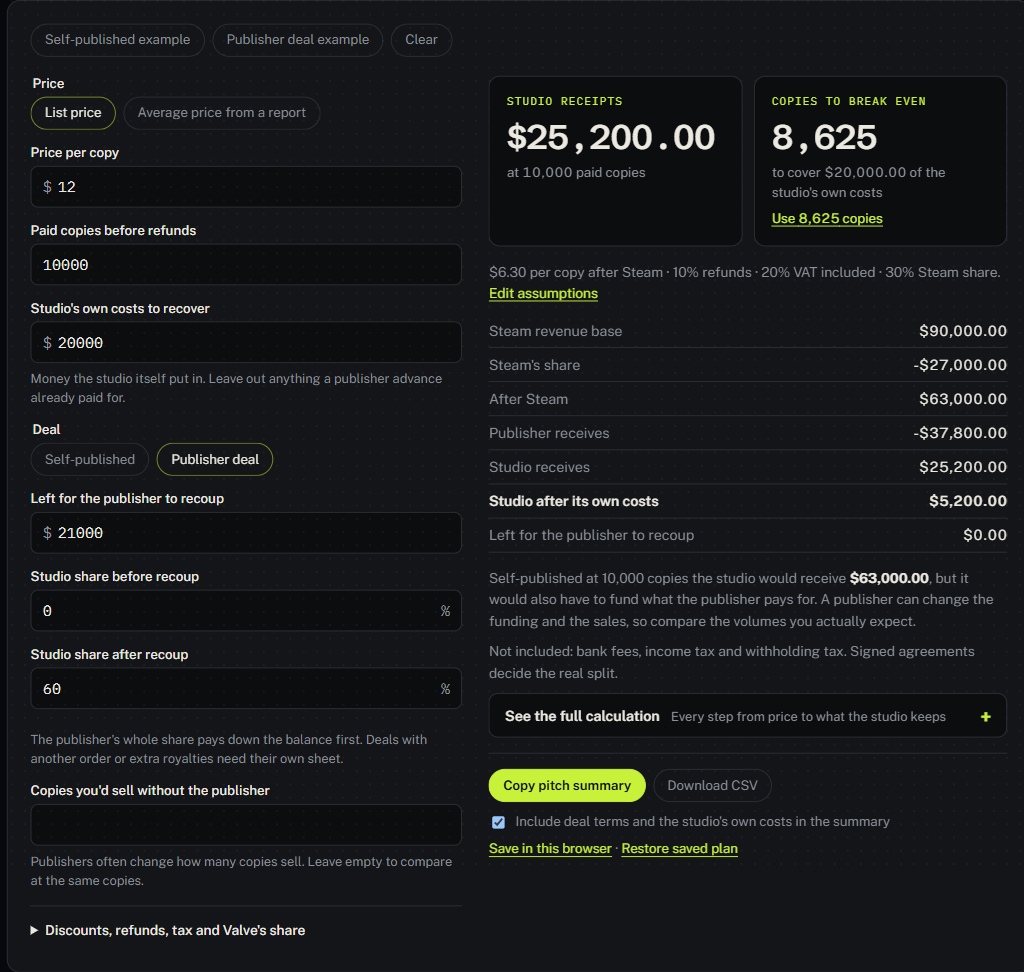
Try this publisher deal with your numbers. Choose Publisher deal example and set the tax to Price includes tax at 20% to match this example, then replace the advance and post-recoup split with the terms you are discussing.
What to put on your publisher pitch slide
There is a second question worth bringing to the meeting. If the studio can sell 10,000 copies on its own, how many would it need to sell with the publisher to come away with the same $22,000 above its cash investment? Under these terms, 14,445 purchases. At that volume the studio has recovered its $20,000 and earned just over $22,000 on top. That gives both sides something specific to discuss when they talk about the publisher’s contribution to sales. It also leaves room for another perfectly good reason to sign: the studio may simply have $20,000 available and no way to finance the rest itself.
For a funding slide, keep the claim small enough to defend:
We’re seeking $21,000 to finish a $41,000 PC release over six months. We’ll contribute $20,000. At $6.30 per purchase after Steam, our cash breaks even at 8,625 purchases under the proposed recoup and 60% studio share.
Put the price, refund assumption and recoup terms beneath that sentence. Keep evidence for expected sales on the next slide. The budget tells a publisher how many sales the project needs. Comparable games, your own demo results or other audience evidence explain why you think it can reach them. Get a free pitch review from WHETHER.
Last reviewed . The figures are illustrative scenarios, not sales data from Whether, its customers or industry averages. Steam's terms change, so check Valve's current documentation and your signed agreements.