How Much Does Steam Take From Game Sales?
Steam generally takes 30% of a game's revenue after applicable taxes, returns and chargebacks. On a $10 purchase before sales tax, with no refund, Valve keeps $3 and the Steam partner receives $7. For a self-published game, that partner is usually the studio. If a publisher distributes the game, the publishing agreement determines how much of that $7 reaches the developer. Valve’s payment reporting FAQ
How much does Steam take on a $12 game?
Imagine a game sells 1,000 copies at $12. Every buyer in this example pays a price that includes 20% VAT. One hundred buyers get full refunds. There are no discounts or other charges, and the game is in Steam’s 30% tier.
| What happened | Amount |
|---|---|
| 1,000 buyers paid $12 | $12,000 |
| 100 purchases were refunded | −$1,200 |
| The remaining 900 purchases included $2 of VAT each | −$1,800 |
| Revenue on which Steam takes its share | $9,000 |
| Valve’s 30% share | −$2,700 |
| Amount left for the Steam partner | $6,300 |
That gives you two perfectly useful numbers. Each of the 900 copies buyers kept earned the partner $7. Each of the 1,000 original purchases earned an average of $6.30. If your sales forecast counts purchases before refunds, use $6.30. If your report already excludes refunded copies, applying the refund rate again understates revenue.
The $2 VAT figure can be easy to miss in a spreadsheet. A $12 price including 20% VAT consists of $10 for the game plus $2 in tax. Divide $12 by 1.20 to find the amount before tax. In a region where sales tax is added at checkout, start from the listed price before that tax. Steamworks tax FAQ
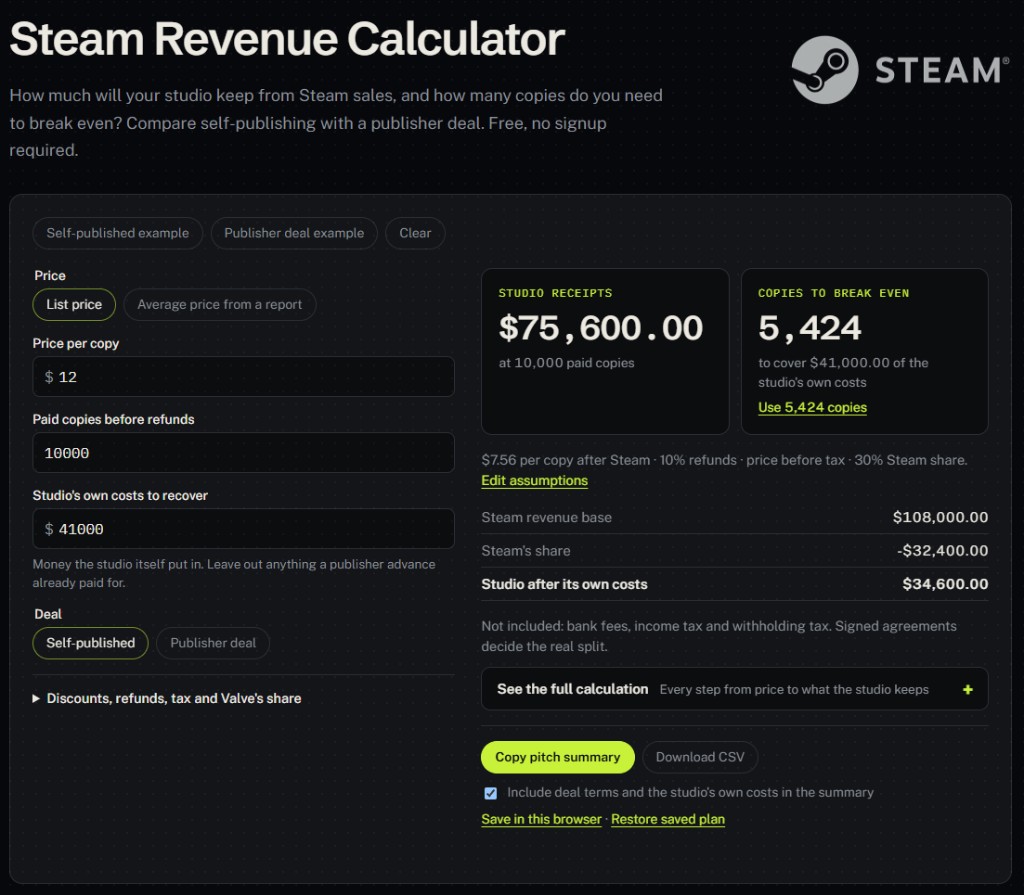
See what your studio keeps at your price in the Steam Revenue Calculator.
What changes if a publisher gets paid first?
Suppose the same $6,300 reaches a publisher. Under an illustrative deal that pays the studio 60% after the publisher has recovered its advance, the studio receives $3,780 if the advance was already fully recovered when these sales began.
Now change just one figure. The publisher still has $2,000 to recover and the deal assigns it all receipts until then. The first $2,000 clears the balance. The remaining $4,300 is split, leaving $2,580 for the studio. Both contracts could be described in a conversation as a “60% developer share.” To forecast the next payment, you also need the outstanding balance and the order in which the money is divided.
Does Steam always take 30%?
Valve publishes marginal revenue-share tiers for eligible revenue from a game. Each percentage in the table applies only to the part of revenue inside its band, not to the game's whole revenue. Valve’s revenue-share announcement
| Portion of eligible game revenue | Valve’s share | Remaining after Steam |
|---|---|---|
| First $10 million | 30% | 70% |
| Above $10 million through $50 million | 25% | 75% |
| Above $50 million | 20% | 80% |
You may also see a 24% figure quoted for Steam. Valve reported that in 2025, partners collectively received 76% of revenue across non-Valve games. Large titles earning revenue in the higher bands help explain the platform-wide figure. If your game is still in the first band, enter 30% in your forecast. Valve’s 2025 review · GameDiscoverCo’s breakdown
For a studio pricing its first release, the difference between a $12 list price and a $9.60 average selling price can matter much sooner. At $9.60, with the same VAT and refund assumptions, average receipts fall from $6.30 to $5.04 per original purchase. That is the figure to take into a budget meeting if you expect an average 20% discount. Work through an indie game budget using those receipts.
Last reviewed . The figures are illustrative scenarios, not sales data from Whether, its customers or industry averages. Steam's terms change, so check Valve's current documentation and your signed agreements.